Keep Calm and Carry On: How to Keep Your Business Moving When the Lights Go Out
“The best time to repair the roof is when the sun is shining.” John F. Kennedy
Infrastructure failures can have an immediate impact on legal practice, whether caused by severe weather, internet or power outages, or transport disruptions. During the January 2026 storms, Tauranga Moana, where I live, was significantly affected. Roads were blocked for more than 24 hours, and power was out for nearly two days. Despite this, court filing deadlines and client commitments remained in place. Waiting for normal services to resume was not an option, and I had to adapt quickly to continue working.
These experiences have caused me to reflect on steps our profession can take to maintain practice resilience as we continue to face environmental and commodity challenges which are placing further stress on our country’s infrastructure networks.
Working in rural locations necessitates being self-sufficient, particularly in respect to power and internet. It also requires using practice systems which can seamlessly continue even if required to work from a home office. However, as demonstrated by the widespread August 2026 internet outage on the North Shore in Auckland, urban New Zealand is not immune to infrastructure challenges. You can find yourself vulnerable, perhaps more so than those living in rural areas where many already have civil defence preparedness.
In my view, given the current state of infrastructure in New Zealand and the events happening internationally, together with the increasing climate volatility and frequency of severe weather events, any practitioner at the independent bar should have a disaster plan which includes how to continue operating your practice when the power, internet and phone networks are not available. Ideally, practitioners should be able to seamlessly operate from either a home office or wherever they may find themselves when disaster strikes.
There are four key areas I consider practitioners should review and assess whether they have sufficient preparedness:
- Power generation when the main grid fails;
- Satellite internet and phone communication;
- Paperless file management; and
- External support networks.
Responding to Power Outages
Solar
An increasing number of households are opting to take advantage of low-interest-rate packages offered by many of the main lenders to instal solar energy systems. There are a number of specialist solar consultants that can assess your home and determine what type of solar system is right for you, as well as helpful websites like mysolarquotes.co.nz where you can compare different systems and get information tailored to your needs.
There are essentially two different types of solar systems which can be broadly described as grid-connected or off-grid.
As the name suggests, grid-connected systems still require maintaining a standard grid connection. It may take time to see the benefits of your solar system and there can be variability in benefits electrical suppliers provide for the purchase of surplus power. However, depending on your choice of system, many modern solar systems may provide you with continued power if the main grid fails.
If you are wanting a truly self-sufficient system, off-grid is likely to be your preferred system. There can be significant cost variance between systems. You need to ensure when getting quotes for solar systems you are clear about what appliances you are running and what your electricity needs are. Technology is changing rapidly. For example, we obtained quotes for a large-scale solar system for our farm in mid-2025. Already the battery storage technology has evolved during this time, and this required a review of the entire system we were planning install to ensure we are future-proofing the farm for solar energy storage. It can be quite overwhelming at times, but the value of asking questions and taking time to compare different systems cannot be underestimated.1
Ultimately, if you have a comprehensive home solar power system which is not reliant on grid supply, then you will be relatively unaffected by main grid power outages. If you do still require some grid supply, then having a further backup plan will be necessary, as will be the case for those households with no solar power system.
Generators
Generators are an alternative when the main power supply is interrupted either for either short or extended periods.
In the event of a power outage, a generator can enable you to continue using key appliances including fridge/freezer, computers, phone/laptop chargers and basic kitchen appliances. They can range in size from portable to permanent. There are two different types of portable generator operating systems: inverter and conventional. Both are commonly powered by 4-stroke petrol engines, although diesel, LPG and dual-fuel models are also available.
In very simple terms they can be summarised as follows:
Inverter Generator - Pros & Cons
- Power Quality: Produces clean, stable power with low harmonic distortion, ideal for laptops.
- Noise Level: Significantly quieter due to enclosed design and variable engine speed.
- Fuel Efficiency: Engine speed adjusts to the load, saving fuel.
- Portability: Usually smaller and lighter.
- Cost: Generally more expensive per watt.
Conventional Generator - Pros & Cons
- Power Capacity: Best for high-wattage needs (tools, job sites, whole-home backup).
- Cost: Generally more affordable upfront for higher power output.
- Noise & Fuel: Generally operates at a fixed engine speed, which can result in higher noise levels and fuel consumption than an inverter generator.
- Power Type: Can produce “dirty” power that can potentially damage sensitive electronics.
There are a variety of different manufacturers of both inverter and conventional generators and as is often the case, you do get what you pay for. We have several generators, ranging from small portable conventional models to large permanently installed industrial units. Each serves a different purpose.
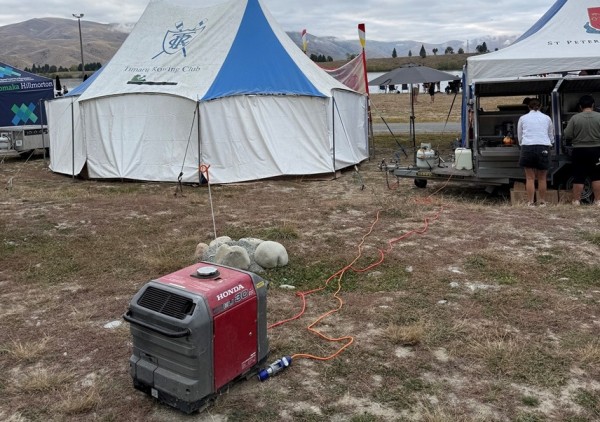
Top: Portable Generator
Our portable Honda generator would now be at least 20 years old and still going strong. It can be lifted relatively easily by two people and is small enough to go in a car boot. It recently enjoyed a trip down south and was used daily to run a portable fridge, kettles and toasters lakeside in Twizel at this year’s Maadi Cup. It did not miss a beat. During previous storms, it has helped local households keep fridges, freezers and other small appliances running.
It has been an invaluable tool in our civil defence kit, happy to sit in the garage until needed and doing its job when required.
Satellite internet and phone communication
During Cyclone Gabrielle, many parts of the North Island, in particular the east coast lost telephone networks for a significant period of time. It highlighted for many how vulnerable our mobile networks are in New Zealand. Now, two of our major mobile network providers, One New Zealand and Spark, have introduced satellite connection utilising Starlink.
We have been using Starlink for our internet service on our farm for approximately four years. Prior to this, we had experienced ongoing instability of our internet connection. Starlink utilises satellites orbiting Earth to provide relatively consistent internet connection for its users. There is a range of monthly user charges depending on your needs. You have a Starlink dish which is ordinarily roof-mounted, although there are also portable options. The Starlink website has a comprehensive summary of the various options available.
Other satellite providers are Gravity, Farmside, and Inspire Net. A useful blog that summarises six of the top satellite providers in NZ can be found here.
You can use satellite internet to operate Wi-Fi phone communication such as WhatsApp, FaceTime, Messenger and other app-based calling services such as VXT. If you are still reliant on general mobile coverage to make calls, then you can enhance your coverage by selecting Wi-Fi calling on your phone.
App-based calling services such as WhatsApp are extremely useful in maintaining communication continuity when the main mobile networks either are compromised or overloaded.
Having a combination of a generator and Starlink has meant that I am consistently able to continue working without interruption when there are power outages and the phone networks go down.
Electronic file management
The merits and necessity for electronic file management systems in our day-to-day legal practice have been the subject of previous webinars and articles published by the New Zealand Bar Association. I am by no means an expert in running a seamless and comprehensive paperless file management system. However, I am grateful for taking on board some of the pointers given by presenters such as Philip Cornegé in past webinars he has presented about operating a paperless office. Microsoft 365, particularly SharePoint, has been invaluable when I have needed to work from home or continue my practice from remote locations in New Zealand and Australia.
Being able to access my electronic files from any location as long as I can access the internet means I am not bound to a physical office space. I am also able to maintain contemporaneous records on each file, regardless of where I am operating from.
I also use a reMarkable Notepad for taking handwritten file notes. This allows me to upload my handwritten notes easily and save them in each client’s electronic SharePoint file.
In January of this year, I had to prepare affidavits for clients remotely when I was unable to see them in my office due to road closure in every direction from my home. Because my electronic file was up to date, including all handwritten file notes, I was able to seamlessly prepare the affidavits without worrying that I could not get to my office and access a hard copy file. I was also able to access all of my legal databases and document precedents from my home office with the benefit of a generator running and my Starlink satellite internet connection.
However, what I was unable to do was print my affidavits and have my clients collect the hard copy affidavits for swearing. It was this last part that highlighted the importance of my final tip.
External support networks
As Barristers we can be at risk of isolation. Unlike the independent bar in the UK and in parts of Australia, many barristers are not operating out of large chambers. Instead, many barristers will have small offices or be more regularly working from a home office. When disaster strikes, having external support networks is crucial, not only for general wellbeing support but also, if required, for professional support.
In my case, when I was preparing the affidavits, as noted, they needed to be printed, and I had to have my clients attend an office to have them sworn. Had it not been for the storm and associated road closures, I would have met my clients at my office. I would have given them printed copies of the affidavits before they attended another legal office to have them sworn. They could then have returned the affidavits to me for scanning and filing.
I had to quickly pivot, and this meant contacting a local firm and asking if they would be prepared to print the affidavits if I emailed them to them and to have my clients attend their office and arrange for someone suitably independent to assist in having the affidavits sworn. They would then need to scan and email them to me so I could file them. Through my connections and collegiality, it was not difficult to find a practitioner ready and available to assist. As such, this final step occurred relatively seamlessly. I was grateful for the assistance.
Maintaining connection and collegiality with local practitioners and firms is so important. Being part of local network groups, attending local professional events, and being part of professional associations such as the New Zealand Bar Association should not be underestimated. It is often when unexpected events occur that you realise the benefit.
Final Reflections
I started writing this article earlier this year. Work intervened, and it was decided I would submit this article for the winter edition of At the Bar.
In that time, we have experienced, as a country, at least three further serious storm events throughout the country. The road I used to take to my office each day has been closed since the January 2026 storm event. What used to be a 15-minute drive to my office is now, on a good day, 45 minutes. Together with the current fuel cost increases, this means that I have had to completely rethink where I have my office and when I go to that office.
We have continued to have power outages in our area. Our power bill has increased dramatically. We are currently part way through a solar installation. We hope that this will further strengthen our infrastructure resilience and independence.
I encourage all practitioners, whether you live in a main centre, a regional area, rural or suburban, to:
- Reflect on your disaster plan and level of preparedness;
- Take the opportunity while the sun is shining and the weather is settled to consider whether you could continue to operate your business if the power goes out and the internet goes down for a lengthy period of time;
- Look at the way you run your practice and consider whether you could work from a home office or some other place away from your office if required;
- Review your local professional networks and consider whether you need to take time to develop or at least check in with others, so you are not practising in isolation.
Genevieve Haszard
Kate Sheppard Chambers
Genevieve sits on the NZBA Council and is the Vice-President for Waikato/Bay of Plenty area. She chairs the Safety and Wellness Committee and is on the Management, Family, Trusts and Estates committees.
REFERENCES
- Independent information on power options is available on the EECA website: Energy Efficiency & Conservation Authority | EECA
Related News
The Bar Association Welcomes New President Dr Simon Foote KC
01 OctoberThe New Zealand Bar Association | Ngā Ahorangi Motuhake o te…
Read moreAccess to Justice Winner 2026 Erin Ebborn
04 SeptemberErin Ebborn has been awarded the 2026 Access to Justice Awar…
Read moreRule of Law Keynote | Roddy Dunlop KC
03 SeptemberAddress to the Bar Association of New Zealand: The Independe…
Read moreAccess to Justice Five Years On
27 AugustFrances Joychild KC was the inaugural winner of the LexisNex…
Read more